
STUDENT RESEARCHER · PUBLIC-RADIO HOST · STEM INNOVATOR
Aryash Shyam
I'm a student researcher, youth innovator, science communicator, and STEM educator based in Pennsylvania's Lehigh Valley. I host Teen Scientist on WDIY, Lehigh Valley Public Radio, an NPR member station; conduct research in CRISPR, space biology, mathematics, and artificial intelligence; and created GreenBeam, an AI-powered robotic prototype for targeted weed treatment in residential lawns.
Through RacingGecko, documentary filmmaking, public radio, and peer mentoring, I work to make complex scientific ideas clear, useful, and accessible.
WDIY, Lehigh Valley Public Radio · NPR
Genes in Space Junior Scientist Award
3M Young Scientist Challenge · State Merit
NASA AIAA Essay Contest · First Place
Member Lehigh Valley ARML Team
3×
Pennsylvania Association of Broadcasters Excellence in Broadcasting Awards (2021, 2023, 2024)
60
Teen Scientist Episodes Aired
6+
National Honors & Competition Awards
2026
Genes in Space Junior Scientist Award Winner
Explore My Work
Four connected areas define my work: investigating scientific questions, building practical technology, teaching STEM, and communicating discoveries to broad audiences.
Science Communication
Teen Scientist, documentary filmmaking, interviews, scientific writing, and public engagement.
AI & Robotics
GreenBeam, computer vision, precision targeting, Python development, and student-built engineering.
STEM Education
RacingGecko videos, mathematics instruction, peer mentoring, and competition preparation.
Scientific Research
CRISPR, space biology, molecular diagnostics, computational genomics, and mathematical modeling.
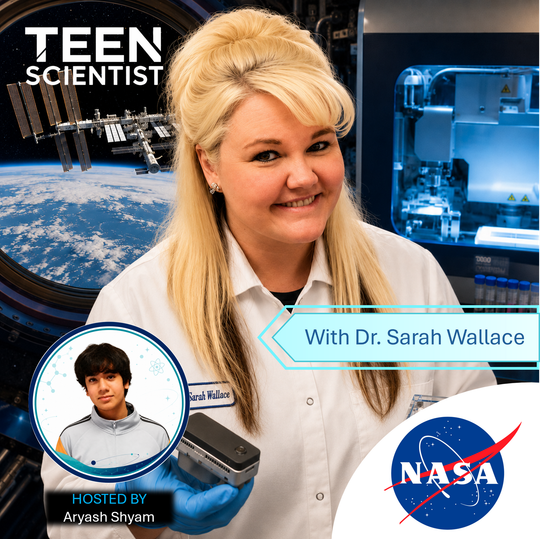
UPCOMING EPISODE · November 5, 2026
The Invisible Crew Aboard the Space Station
with Dr. Sarah Wallace · NASA Johnson Space Center
The International Space Station is the cleanest, most carefully engineered spacecraft humans have ever built, yet run a swab across a single handrail, and you are very much not alone. Every crew member, meal, and cargo delivery carries trillions of tiny stowaways: bacteria and fungi that live in the air, water, and on the surfaces of the station. On this episode of Teen Scientist, host Aryash Shyam talks with Dr. Sarah Wallace, a microbiologist at NASA's Johnson Space Center whose team made it possible to sequence DNA in space for the first time, about the invisible ecosystem that travels with astronauts, and why NASA works so hard to keep track of it.
Dr. Wallace explains how NASA moved from 'grow and return' (flying samples all the way back to Earth just to ask what they are) to 'sequence in orbit,' using a candy-bar-sized device called the MinION that reads DNA by threading it through tiny pores. She and Aryash explore why most microbes are not villains, how knowing what is growing on a spacecraft protects both the crew and its water system, and why identifying microbes on board becomes essential on long missions to the Moon and Mars. It gets personal, too: Aryash, a Genes in Space Junior Scientist Award winner, asks what advice she would give students designing biology experiments they hope could one day fly in space.
Space Biology · NASA · DNA Sequencing · ISS · Microbiology · Genes in Space
Latest Episode · OCTOBER 1, 2026
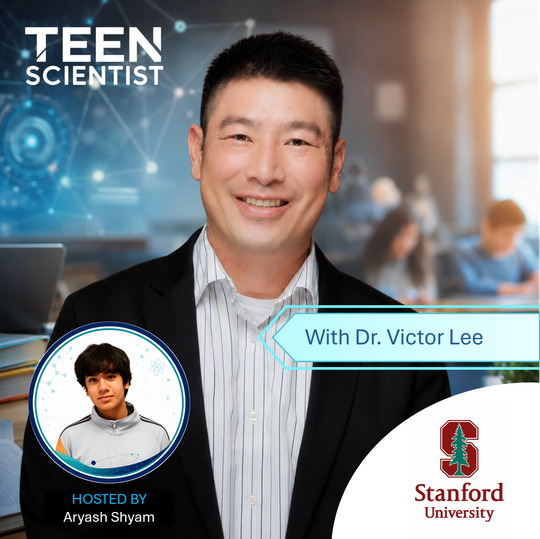
Are You More Than Your Data?
with Dr. Victor Lee · Stanford Graduate School of Education
Your watch says you slept badly. Your phone says your screen time is up. A school app says your grade is slipping, and your feed somehow knows the next thing you'll watch. But how much of 'you' do those numbers really capture? On this episode of Teen Scientist, host Aryash Shyam talks with Dr. Victor Lee, a professor in the Stanford Graduate School of Education, about how data quietly shapes the way we see ourselves, our schools, and the world around us.
Dr. Lee explains why data is never simply 'found' — it is made, through human choices about what to count, what to ignore, and what story a number is supposed to tell. He and Aryash dig into sleep scores, step counts, grades, recommendation feeds, wearable trackers, and the famous 10,000-step goal that began as a marketing slogan, and explain why data literacy — learning to question a number before you trust it — may be one of the most important skills of the AI age.
Data Literacy · AI Literacy · Stanford · Wearables · Algorithms
John Estey Student Writing Competition: Middle School Winner
I was named one of four 2026 Middle School winners of the John Estey Student Writing Competition, presented by the American Writers Museum in Chicago, for my historical fiction piece, “The Weight of Lead.” The story is set in a Philadelphia print shop on July 4, 1776, and explores the tension between the Declaration of Independence’s promise that “all men are created equal” and the realities surrounding its publication. The award includes a $1,000 prize, and the winning work is published by the museum.
American Writers Museum · Creative Writing · Historical Fiction · American History
ANSI 2026 Student Paper Competition: First Place, High School
I won first place in the high school category of the 2026 American National Standards Institute Student Paper Competition for my paper, “Designing Out Error: How ISO 80369 Turned a Deadly Universal Connector into a Life-Saving Standard.” Drawing on my experience as a surgical patient at Children’s Hospital of Philadelphia, the paper examines how the ANSI/AAMI/ISO 80369 family of standards redesigned medical tubing connectors so incompatible systems cannot be accidentally connected, helping build patient safety directly into medical device design.
American National Standards Institute · Standards · Engineering · Medical Device Safety
John Locke Institute 2026: Two Very High Commendations and One High Commendation
In the 2026 John Locke Institute Global Essay Prize, all three essays I entered were shortlisted from a field of 100,227 entries worldwide. My Economics and Philosophy essays went on to receive Very High Commendations, while my Science and Technology essay received a High Commendation. I was also invited to London in October for the John Locke Institute’s invitation-only academic conference, Awards Ceremony, and Gala Dinner.
Very High Commendation · Economics & Philosophy | High Commendation · Science & Technology
In the News
Selected media coverage of my work in AI, robotics, scientific research, broadcasting, and STEM.
Featured Coverage
Let's Connect
Whether you're an admissions officer, a journalist, or a STEM enthusiast, I'd love to hear from you. For collaborations, media inquiries, speaking requests, or just to say hello.